
About this course
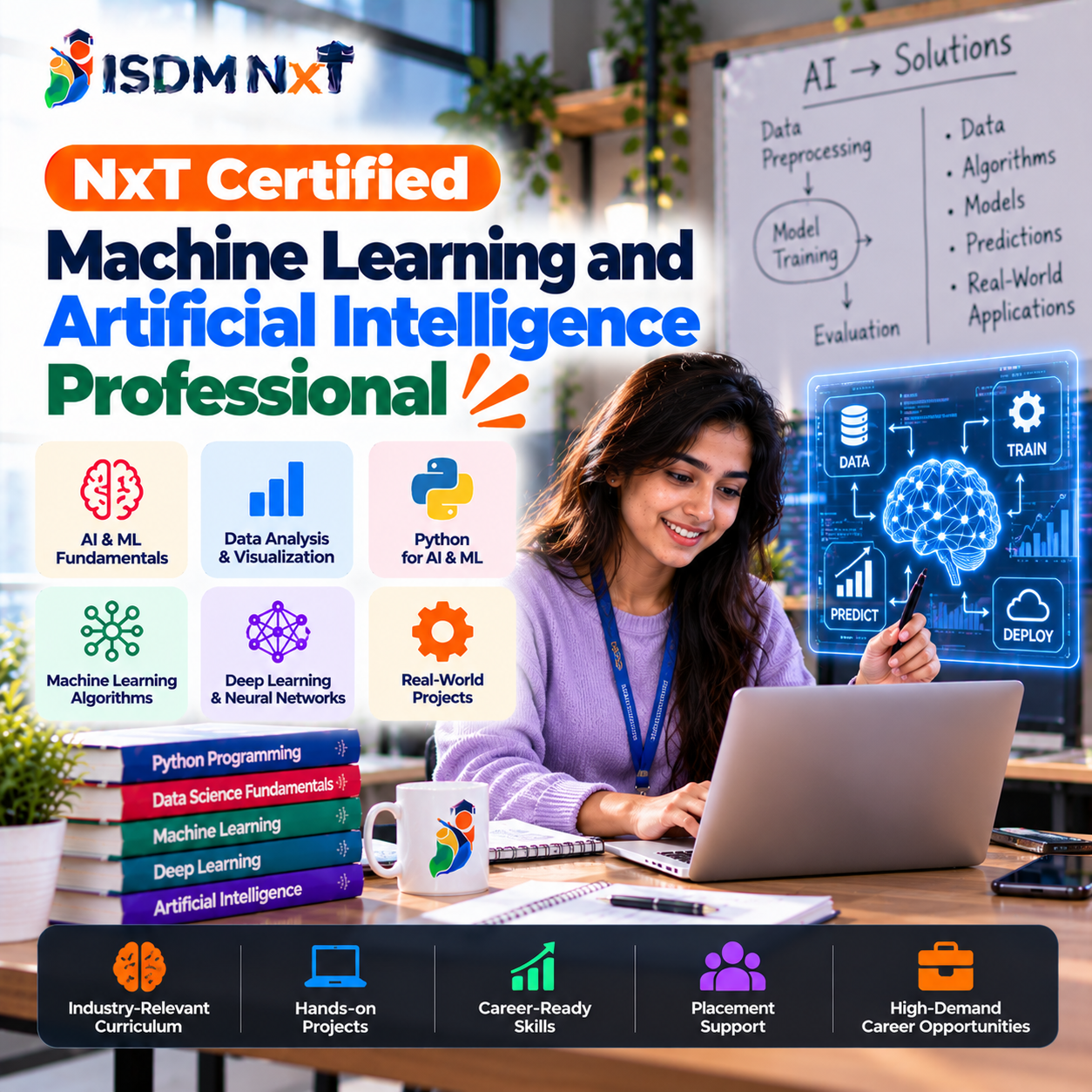
Become a leader in the field of artificial intelligence and machine learning with the NxT Certified Machine Learning and Artificial Intelligence Professional course. This comprehensive program covers fundamental concepts, advanced techniques, and practical applications of machine learning and AI.
- Understand the theoretical foundations of AI and machine learning.
- Gain hands-on experience with real-world datasets and projects.
- Learn about neural networks, natural language processing, and computer vision.
- Develop skills in Python, R, and various machine learning libraries.
Tools you will master
Hands-on practice on the same software that companies use every day.
 Python
 TensorFlow
 Pandas
 Jupyter
 AWS
 Google GeminiAI
 GitHub CopilotAI
 VS CodeAI
 GitHubAI
 ClaudeAI
 PerplexityAI
 NotebookLMAI
What you will study, module by module
- Overview of Machine Learning
- Types of AI
- Applications of AI
- Basic Statistics
- Linear Regression
- Logistic Regression
- Decision Trees
- Model Evaluation Metrics
- K-Means Clustering
- Hierarchical Clustering
- Dimensionality Reduction
- Anomaly Detection
- Introduction to Neural Networks
- Convolutional Neural Networks
- Recurrent Neural Networks
- Transfer Learning
- Text Processing Techniques
- Sentiment Analysis
- Chatbot Development
- Word Embeddings
- Time Series Analysis
- Forecasting Models
- Financial Data Analysis
- Risk Management with AI
- Model Deployment Techniques
- Using Cloud Platforms
- API Development
- Scaling AI Solutions
- Real-world Project Work
- Ethical Considerations in AI
- Presentation Skills
- Team Collaboration
- AI Basics and Everyday Uses
- Generative AI: How It Works
- Prompt Engineering Foundations
- AI for Study and Workplace Tasks
- Fact-Checking and Reliable Research
- Privacy, Safety and Responsible Use
- Integrated Practice and Review
- AI Pair Programming Setup: VS Code and GitHub Copilot
- AI-Assisted Front-End Development
- Python Coding and AI Agents in the Editor and Terminal
- GitHub Team Workflow and AI Code Review
- Calling AI APIs from Your Own App
- AI-Assisted Testing, Debugging and Documentation
- AI-Assisted Deployment and Final Project
After this course you will be able to
- Understand key concepts of machine learning and artificial intelligence.
- Implement machine learning algorithms using Python and R.
- Analyze and visualize data using various tools and techniques.
- Design and deploy machine learning models in real-world applications.
- Evaluate model performance and optimize algorithms.
Projects you will build
Predictive modeling using regression techniques.
Sentiment analysis on social media data.
Image classification project using convolutional neural networks.
Building a recommendation system for e-commerce.
Jobs you can get after this course
Salary ranges are approximate for freshers in India and depend on city, company and your skills.
Who hires for these skills
Earn on your own
- AI chatbot development for businesses
- Data analysis projects for startups
- Freelance ML model training
- Consulting on AI strategy
- Creating online courses in AI
Is this course for you?
Best for
- 12th pass students
- Graduates seeking specialization
- Job seekers in tech
- Working professionals upskilling
- Entrepreneurs wanting to leverage AI
Eligibility
Bachelor's degree in any field or equivalent experience in programming and statistics.
What you get with ISDM NxT
Upon successful completion, you'll receive a certificate from ISDM NxT, showcasing your skills in AI and Machine Learning.
How we help you get a job
- 1
Resume building workshops
- 2
Mock interview sessions
- 3
Access to job offers
- 4
Guidance on job applications
Your certificate & marksheet
After passing the final exam you receive an ISDM NxT certificate and marksheet like these. Tap to view.
Sample only - the real certificate carries your name, photo, marks, enrolment number and a QR code for online verification.
What next after this course
Questions students ask
The course duration is 1 year.
The total fee for the course is ₹50,000.
A bachelor's degree or equivalent experience in programming and statistics is recommended.
You will work on various projects including predictive modeling, sentiment analysis, image classification, and recommendation systems.